
Mentoring by Design
Recognition
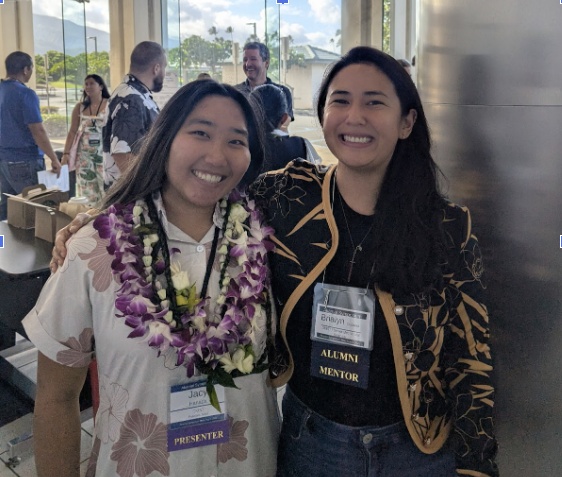
Feeling recognized for ideas, contributions, and accomplishments is something all people need. Forms of recognition can be formal, such as when interns present at the symposium, but recognition also includes many day-to-day interactions at the workplace, such as during meetings, as members of teams interact, or during mentoring.
Disparities in who gets recognized
Unfortunately, recognition can be overlooked or undermined in ways that can lead to inequitable outcomes. For example, relative to their male colleagues, women in STEM–and even more so women of color in STEM–often report having to prove their competency over and over again (Williams, 2014). This is an example of what authors have termed a “prove-it-again” bias in which women feel they have to provide more evidence of competence than men in order to be seen as equally competent. For example, “situations where women suggest an idea which is overlooked, only to have the idea taken up when it is repeated by a man.” Each instance may not have a significant impact, but collectively these experiences can add up to marginalize those whose bids for recognition are ignored.
Recognition, STEM identity, and STEM persistence
Intuitively, it is easy to grasp disparities such as stalled career advancement that arise from inequitable recognition amongst peers. Moreover, there is a significant body of research that illuminates a more problematic and longer-term impact: lack of recognition as a scientist leads to lack of forming an identity as a scientist, which can lower likelihood of persistence in STEM. A framework for STEM identity has emerged that emphasizes competence, performance, and recognition (Carlone & Johnson, 2007). In this framework, competency is viewed as not just knowledge but proficiency with valued skills (e.g., STEM practices). Performance is the demonstration of scientific practices in professional settings within the authentic culture of STEM (and in classrooms). The third component is explicit recognition of competence and performance in ways culturally appropriate for STEM. The researchers found that competence and performance were not enough to predict the science identity development of the women of color in their study; recognition was needed and harder to get.
References
Williams, J. C. (2014). Double jeopardy? An empirical study with implications for the debates over implicit bias and intersectionality. Harvard Journal of Law & Gender, 37, 185.
Carlone, H. B., & Johnson, A. (2007). Understanding the science experiences of successful women of color: Science identity as an analytic lens. Journal of Research in Science Teaching: The Official Journal of the National Association for Research in Science Teaching, 44(8), 1187-1218.

Leaders and Funding
This website is based on the work for the Akamai Workforce Initiative led by the Institute for Scientist & Engineer Educators at University of California, Santa Cruz.
Development of this website was funded by the Gordon and Betty Moore Foundation, the National Science Foundation (AST#1743117 & AST#2034962), and the Hawaii Community Foundation.
Address
Institute for Scientist & Engineer Educators
Mailstop: UCO/Lick Obs ISEE
1156 High Street
Santa Cruz, CA 95064
Email: isee@ucsc.edu